People have been tweeting about receiving their copies of To Spin a Darker Stair, and they are saying such lovely things!
Faith Mudge, one of the authors, sent me a beautiful note, and I hope she won’t mind me quoting her description: “The book is gorgeous – so small and sweet, a bookling really!” I LOVE it – bookling indeed!
Artist Kathleen Jennings talks us through the process of the cover art on her blog – so PRETTY.
DarkMatterzine has already reviewed it! Nalini says: “I’m charmed by the book … these are re-imaginings from the dark side.” (among other nice things).
And on Twitter, Tansy Rayner Roberts called it, “a fairy cobweb of a … book.” Beautiful!
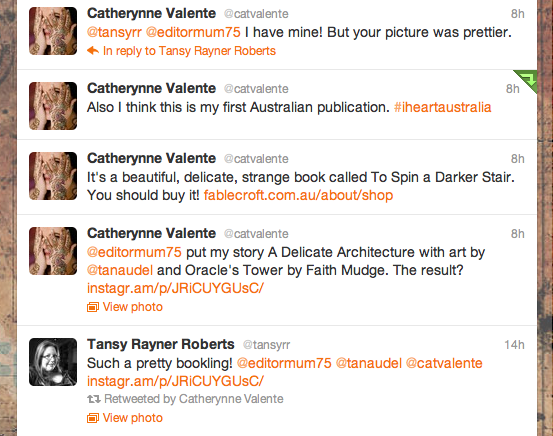
And finally (for now!), author Catherynne M Valente also had some things to say on Twitter – I’ve captured it as a picture to have forever! My favourite bit? “… a beautiful, delicate, strange book…”
If you’d like a copy too, pop over to the Shop and pick one up!
The shortlists were announced tonight and there are some wonderful works on the lists. We’re delighted to see Thoraiya Dyer’s fabulous story “Fruit of the Pipal Tree” from After the Rain shortlisted for Fantasy Short Story. Well done Thoraiya! The shortlists can be found here. Congratulations all!
Sneak peek at part of the gorgeous cover art for To Spin a Darker Stair (art by Kathleen Jennings)
It occurred to me today that I have a marvellous opportunity to give readers (even more) incentive to pre-order their copy of FableCroft’s forthcoming gift book, To Spin a Darker Stair. The book features stories by Catherynne M Valente and Faith Mudge, and is illustrated by Kathleen Jennings.
Last month I accidentally ended up with an extra copy of Sea Hearts, the newest novel from the marvellous Margo Lanagan (I reviewed it here). I highly recommend it, so I’m offering it up as a pre-order prize! One lucky person who pre-orders To Spin a Darker Stair before March 15, 2012, will win Sea Hearts as well (drawn randomly from all pre-orders).
So, for just $7.95 (Australia), $8.95 (New Zealand) or $9.95 (rest of the world) you have the chance to get not just one but TWO awesome (beautiful) books! Don’t miss out on your chance to win – pre-order now! **
** Winner will be drawn from all pre-orders prior to March 15, 2012, including those already placed.
It is with great pleasure that I announce the table of contents for Epilogue (the anthology formerly known as Apocalypse Hope). I had more than 200 submissions for this anthology, many of a very high quality, and it was difficult task to sift through them to pick out the finest gems. I present the final lineup, and look forward to bringing these stories to you in print.
“Time and tide” by Lyn Battersby
“Fireflies” by Steve Cameron
“Sleeping Beauty” by Thoraiya Dyer
“The Fletcher test” by Dirk Flinthart
“Ghosts” by Stephanie Gunn
“Sleepers” by Kaia Landelius
“Solitary” by Dave Luckett
“Cold comfort” by David McDonald
“Mornington ride” by Jason Nahrung
“The last good town” by Elizabeth Tan
“A memory trapped in light” by Joanne Anderton
“Only the books survive” by Tansy Rayner Roberts
Thank you to every author who sent in submissions, which came from all around the world – some rejections were very difficult to make, and I wish those authors the very best in finding their stories a home.
For those interested, the final contents include 12 stories, eleven by Australians and one from Sweden. There are seven female authors, and five male. The stories are all original to the anthology.
I’m delighted with the line up for Epilogue, and can’t wait to show it to you all!
Thank you to everyone on Twitter and Facebook who made title suggestions for renaming Apocalypse Hope. There were some wonderful titles put forward, and I loved a number of them (just so you know, After the Apocalypse wasn’t a contender because Maureen McHugh had a collection titled that this year. After the End was another popular suggestion, but there’s a 2005 zombie movie by that name!). The voting was tight as well, so obviously the titles put forward were appealing to many people – makes it tough to figure out a decision! However, after a long and thoughtful process, culminating in a face to face discussion yesterday, the winner has been decided! The anthology formerly known as Apocalypse Hope will be published as…
EPILOGUE
Thank you to @RattusAsh on Twitter (shared by @debkalin) for the suggestion – as promised, I’ll send you a free copy of the anthology when it comes into the world! Thanks again to everyone who made suggestions and voted – your input was appreciated more than I can say 🙂
While the table of contents for the anthology previously known as Apocalypse Hope is almost finalised, I am struggling to decide on the new title that more accurately reflects these new contents. With the help of Twitter and Facebook, I have shortlisted some wonderful title suggestions and would love for you to pick your favourite! Vote here.
And remember, the FableCroft Massive Moving Sale ends in just one week – don’t miss out on the best book bargains for Christmas!
It took me a little longer than I’d intended (illness and other family matters intervened for a few weeks, holding up the process), but I’ve just completed the first round of slush reading for Apocalypse Hope. Here’s some interesting facts from my submissions pool:
213 submissions in total. 212 by email, 1 by snail mail (guidelines stated email submissions only)
Total word count (e-subs only) approximately 903,641.
GENDER of authors
86 female (40.38%)
122 male (57.28%)
5 unknown (2.34%)
COUNTRY of origin
78 Australia (36.62%)
2 Austria (0.94%)
1 Bulgaria (0.47%)
9 Canada (4.22%)
1 China (0.47%)
1 Denmark (0.47%)
2 Greece (0.94%)
1 India (0.47%)
1 Ireland (0.47%)
1 Malaysia (0.47%)
1 Singapore (0.47%)
1 Sweden (0.47%)
1 Thailand (0.47%)
1 The Netherlands (0.47%)
9 UK (4.22%)
103 USA (48.36%)
ACCEPT/REJECT/HOLD
1 submission withdrawn as it was accepted elsewhere (guidelines stated no simultaneous submissions) (0.47%)
2 held with rewrite requests (0.94%) (both female)
4 accepted on first round reading (1.88%) (all Australian; 2 male, 2 female)
36 held for second round reading (16.9%) (11 Australian, 17 US, 2 Canada, 1 Denmark, 1 Ireland, 1 Singapore, 1 Sweden, 1 Thailand, 1 UK; 14 female, 22 male)
170 rejected (79.81%)
OTHER STATS
13 stories were rejected for not meeting the guidelines (6.1%) – these included reprints without query and stories outside the word count without query.
6 authors queried for outside word count (2.82%) – of these, one was accepted in first round, and one was held for second reading.
3 stories were submitted in formats unable to be read by the editor (1.41%)
ETA: I had quite a lot of queries to submit reprints. Most of these I decided not to consider, as they were published very recently. I had eight reprint submissions I looked at (some not queried – these were not read. I also had one that was not queried, and the author did not even advise me it was a reprint. It was pure chance I googled the story before replying to the author, and discovered the story provenance). Of these, two are on hold for second round.
I also forgot to mention I had one poem submitted (after query) – it too is on hold.
A reminder that my area is editing, not mathematics 🙂
So it turned out we had one laggardly author with indie publishing thoughts to share – the indomitable Dirk Flinthart tells it like it is…
Photo courtesy of Ellen Datlow
So, what’s it like working with small press in Australia?
Except for the money, it’s bloody fantastic.
Take a look at the last few years worth of Ditmar and Aurealis awards. You will notice that except in the novel-length categories, small press is wildly over-represented. Why?
Well, you could argue that the big press has no real interest in short stories, novellae, anthologies, and so forth. But look more closely. Ask yourself why that’s the case, and you’ll find it comes down to one thing: money. The big kids don’t want to put money into shorter works because there’s not enough profit in it for them. Meanwhile, the poor small press folks have trouble competing at the novel length because quite honestly, most of us who write a novel-length MS would rather like to be paid for it … and small press can’t manage that. Yet.
I’ve had a damned good time working with small press in Australia. To date, I’ve found the people doing the editing and publishing are energetic, co-operative, friendly, skilled, and helpful. Best of all, they’ve got that rarest and finest of qualities: a sense of wonder. They’re in it because they love this stuff. The small press people are doing the hard yards. They’re uncovering new writers, people with interesting voices and personal viewpoints. small press takes risks, and in so doing, makes us all much richer.
Take Cat Sparks’ agog! press, for example. Aside from the rather fine series of anthologies of that very name, Cat was kind enough to give me the opportunity to create theCanterbury 2100 anthology. It was an unusual, experimental form: not a ‘future history’, but an anthology of future oral fiction, aimed at depicting a possible England in 2100 or so by showcasing the kind of stories that people from that future might tell to each other.
In terms of sales and reviews, we didn’t achieve much, limited as we were in our print run and distribution. On the other hand, out of something like twenty stories, I can point to first (or very nearly first!) sales to Thoraiya Dyer, L. L. Hannett, and Laura Goodin – all three of whom have gone from strength to strength. The anthology also picked up an early piece from Matt Chrulew, and another first from Durand Welsh.
Big Press doesn’t do that. By the time you’re printed in the big press, either they’re taking a punt because they hope you’re the next Matthew Reilly, or you’ve already done the weary rounds of magazines and small-press anthologies. Big Press doesn’t take risks because Big Press is there to make money. They’ll put $300 million worldwide into advertising a sure thing (the last Harry Potter novel being the case in point) but they won’t risk $50,000 to try out someone genuinely new and interesting.
I’ve got no objection to money. But I do object to lack of vision. It’s fine to keep churning out the same old stuff in genres like crime and romance. But science fiction and fantasy? Most of us got into reading this stuff because it offered a new vision, a chance to escape the familiar and discover something dangerous, something daring. The point of speculative fiction is speculation, and therefore, risk.
And this is why I love the small press folk, particularly here in Oz. Look at the work being done by Twelfth Planet Press, with its collections of work by new female voices. Consider the last-gasp publication of Paul Haines’ big collection by the late, lamented Brimstone Press – or Mr Haines’ career in general, if you will. Haines has what I think is the most original and viscerally disturbing voice I’ve seen in a generation of horror writers, with more awards under his belt than is really legal … and he doesn’t have a contract with the big kids. My guess? Probably it’s because he doesn’t sound like Stephen King, or Dean Koontz, or someone else with a few million sales behind them. He’s a new and demonstrably different talent, you see. Risky.
Small press takes risks, gets to be creative and discover new voices. Big Press waits, and invests big money in what it hopes are sure things. Is that a reasonable state of play? Can we live with this, as writers and as readers?
Sadly, no. The small press game burns people out. It costs money, and it takes time. Editing and layout require tremendous concentration at a high level of skill. Dealing with writers takes diplomacy, tact, and strength of will. Getting books together, getting them printed and launched and distributed, making sure the money goes to the right places: that’s a full-time kind of job, and unfortunately, it doesn’t pay full-time money. We get wonderful, brilliant people coming into the small press here in Australia, but it wears them down.
It’s not much better at the other end. Big companies get bought by even bigger companies. Costs get cut. Editors and sub-editors get canned. Fewer risks than ever are taken. When you’re down to just a few big players, the potential outlets for new writers are vanishingly small.
In the end, nobody wins.
Change is coming via the Internet. The rise of e-readers, tablet computers and smartphones as reading platforms is already reshaping the marketplace. Self-publishing is now ridiculously easy, and everybody’s doing it.
Into this fray Amazon has entered, signing up new writers as aggressively as it promoted its Kindle reader. This isn’t good from the reader’s viewpoint. Amazon’s Kindle is a nasty bit of work, with a proprietary format to lock their content away from other devices, and an inbuilt backdoor so Amazon can retain control over everything on the system. You don’t really buy books for the Kindle: you lease them until Amazon says otherwise. With an already massive market presence, if Amazon becomes the major online publisher, simultaneously applying leverage with the Kindle as the most popular reading platform, we’re just going to see the promise of e-publishing turn into a new ‘Big Press’ situation.
However, there’s one line in that NY Times article which really stands out to me. Russell Grandinetti of Amazon is quoted as saying: “The only really necessary people in the publishing process now are the writer and reader. Everyone who stands between those two has both risk and opportunity.”
That’s interesting. It reflects the point of view of a market-man, a person who lives and dies by sales, and figures, and money. But it doesn’t quite reflect the reality of the situation, because the truth is that with so many people churning out books, readers aren’t simply spoiled for choice: they’re drowning in it. Sadly, most of those choices aren’t good. Of every hundred new SF novels self-published into e-print, experience says that ninety-nine will be pretty damned ordinary. I speak here as a slush-reader (for small press, of course) of considerable experience.
Perhaps the reader and writer may be the only ‘necessary’ elements in this new marketplace, but a good, critically-savvy gatekeeper with a reasonable public profile is extremely damned helpful. With Amazon moving to establish a monopoly around the Kindle and its existing book-sales business, it looks very much as though the time is right for someone with a track record in finding new talent and bringing it to the light. Someone who already knows how to work with an author, edit an MS, lay out a book in a readable form, and place it attractively in the market.
In fact, I’d say the situation is just about ripe for someone in small press to hit the big time.
Dirk Flinthart is a writer, mostly of speculative fiction, who lives in Northeast Tasmania. Every year he gets a little older, which alarms him at times, until he remembers the alternative. Between teaching martial arts, raising kids, and maintaining a chunk of rural property, he’s a lot busier than he ever hoped he’d be, but writing is still his first love, and he’s just taken on a Masters degree … because he’s a glutton for punishment. Flinthart has won the occasional award, been published in most of Australia’s small presses, written non-fiction and humour (and a best-seller with John Birmingham) and likes to cook dangerously spicy food. How much more does one need from a life?
I wanted to express my appreciation to all the wonderful professionals who generously gave of their time to write posts for the “On indie press” series. It was fascinating to read about all the different experiences people have had, and the widely varying points of view. I hope that you’ve enjoyed reading them as much as I have!
Here is a full list of the posts for the On Indie Press series. Thank you again to all the contributors!





 FableCroft